|
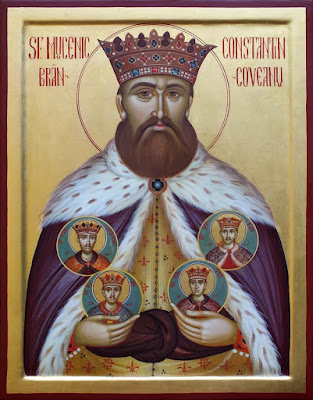
Saint Constantin Brancoveanu: Saint Constantin Brancoveanu The holy Prince Constantin Brancoveanu, the son of Prince Matthew Basarab, was born in 1654. When his parents died, he was raised and educated by his uncle, Constantine Cantacuzino. When another uncle, Prince Serban Cantacuzino died on on October 19, 1688, Constantin was chosen to succeed him as Prince of the Romanian Land (Wallachia). Saint Constantin was a wise and just ruler who was guided by Christian principles, and worked for the benefit of his people. He also built and restored many churches and monasteries. His philanthropy extended even into Transylvania and Moldavia, which were ruled by others. In 1714, after a reign of twenty-five years, Saint Constantin, his sons (Saints Constantin the Younger, Stephen Brancoveanu, Radu Brancoveanu, and Matthew Brancoveanu) and his sons-in-law were arrested by soldiers sent to Bucharest by Sultan Ahmed III (1703-1730). The prisoners were brought to Constantinople, where they were tortured for four months. Prince Constantin was told that if he and his sons wanted to escape death, they would have to convert to Islam and pay a large sum of money. Constantin did not have the money required by the Turks, and he did not wish to convert to the Moslem faith. Seeing that neither tortures nor threats would induce the prisoners to forsake Christ, the Turks sentenced them to death. Before his own execution, Saint Constantin had to watch as his sons were beheaded before his eyes. On the Feast of the Dormition (August 15), the sixty-year-old prince, his sons, and his counsellor Ianache Vacarescu died as martyrs for Christ. Their bodies were left unburied for three days, then they were thrown into the sea. Their relics were recovered by Orthodox Christians who brought them to the Monastery of the Theotokos on the island of Chalki. Saint Constantin’s wife Marica brought his holy relics back to Bucharest and placed them in the church of Saint George the New, which he had founded. Arrest and execution Such policies were eventually denounced to the Porte. Brâncoveanu was deposed from his throne by Sultan Ahmed III, and brought under arrest to Istanbul, where he was imprisoned in 1714 at the fortress of Yedikule (the Seven Towers). There he was tortured by the Ottomans, who hoped to locate the immense fortune he had supposedly amassed. He and his four sons were beheaded on the same day in August, together with Prince Constantin's faithful friend, grand treasurer Ianache Văcărescu. Most importantly, Constantin and his sons were asked to renounce Christianity and join the Islamic religion, which would pardon them from beheading. They chose to keep their Christian faith. According to his secretary, Anton Maria Del Chiaro, their heads were then carried on poles through the streets of Istanbul, an episode which caused a great unrest in the city. Fearing a rebellion, including from that of the Muslim population which was outraged by the injustice done to the Prince, his sons and his close friend, he ordered for the bodies to be thrown into the Bosporus. Christian fishermen took the bodies from the water, and buried them at the Halchi Monastery, in the city's vicinity. He was canonized by the Orthodox Church of Romania in 1992. 
|
Home
|Castles
|Monasteries
|Map
|Paintings
|Literature
|Music
|Sculptures
|Links
|Encounters
|E-mail
|Chat
|Messages
 Dracula's Castle Radio © Copyright 1997-2026 |